
Plympton Lawn Tennis Club
A Story of Tennis, Community and Champions

Plympton Lawn Tennis Club
Harewood Close, Plympton, Plymouth, Devon, PL7 2AS
Acknowledgements
This history of Plympton Tennis Club is dedicated to all the past and present players who have been part of the club and created so many wonderful memories over the years. Their enthusiasm, friendship, and commitment have helped shape the club into what it is today.
Writing this history has been a challenging task. Until now, there was no documented history of the club, and extensive research in local archives revealed very little information about its early years. At times, it seemed that much of the club’s story might be lost forever.
However, a fortunate encounter on Friday 30th January 2026 changed everything. During a spur of the moment visit to the Plympton & District Civic Society based in one of the rooms at Harewood House, I met a lady named Rose Hamley. Had it not been for that visit, I doubt that much of the information contained in this document could ever have been discovered.
Rose introduced me to David Gent, who was visiting Plymouth to conduct research into his own family history and to watch his beloved Plymouth Argyle play the following day. During our conversation, which lasted for over an hour, David told me that he had played tennis at Plympton Tennis Club when he was eighteen years old. His memories, knowledge, and willingness to share information provided an invaluable link to the club’s past and opened doors to further research that helped make this history possible.
I would therefore like to express my sincere gratitude to Rose, David Gent, Rodger Ruse and everyone who contributed information, memories, photographs, and encouragement. Without their help, this record of Plympton Tennis Club’s history could not have been written.
Most importantly, this history belongs to all those who have played, volunteered, supported, and enjoyed the club throughout the years. It is their story, and it is preserved here for future generations to appreciate and enjoy.
“We look forward to building on this proud history for many years to come.”
Kevin Wilkins
Trustee
Plympton Lawn Tennis Club
6th May 2026
© 2026 Plympton Lawn Tennis Club. All rights reserved.
This document and its contents, including text, images, and historical records, are the property of Plympton Lawn Tennis Club. No part of this publication may be reproduced, distributed, or transmitted in any form or by any means without prior written permission from the club, except for brief quotations used for reference or review purposes.
The Beginning
On a winter’s evening, on 24th January 1961, at precisely 7:30 pm, a small group gathered with a shared purpose. They could not have known that the meeting they were about to convene would shape more than six decades of sporting life in Plympton.
There was no grand clubhouse, no floodlights, no polished honours boards filled with names. There was simply a vision.
Among those present were Fred Ray, who would become the Club’s first Chairman, David Crocker, and Stuart Coppleston (Treasurer), Tony Fuller, Fred Ruse, Rodger Ruse, a handful of determined supporters. Historical diary entries from Rodger Ruse record the moment plainly — but what they describe was anything but ordinary. That meeting marked the birth of Plympton Lawn Tennis Club.
The Manor House above the Courts
Before tennis balls ever struck fresh tarmac, before chalk lines were carefully drawn, Harewood Manor House stood watch.
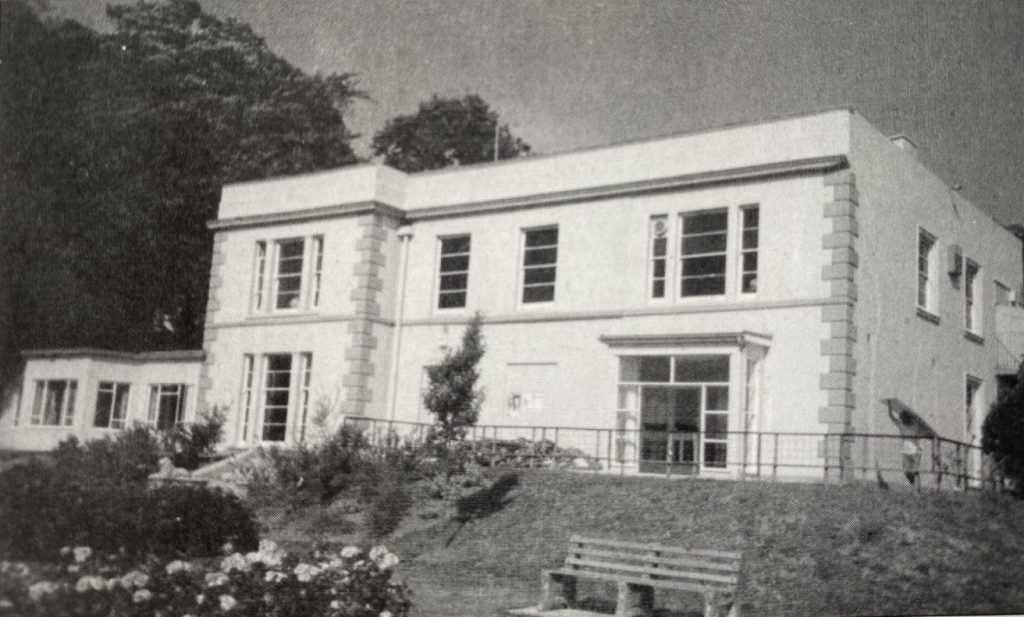
From the Cricket Pitch, the view must have been quietly magnificent. Rising above the sweep of Harewood Park, the white manor house stood in serene command, its pale façade luminous against deep green lawns. Set upon higher ground, it did not merely overlook the tennis courts, bowling green and cricket pitch — it presided over them.
The land itself had been sold to the Plympton Rural District Council in 1949, marking the beginning of its transformation into the recreational heart of the community. Plans soon followed: a cricket pitch, four tennis courts (which opened in 1961), and the later arrival of the pavilion and indoor viewing area with modest but welcoming facilities. In a later development, a bowling green and clubhouse was opened in 1962.
For a time, sport and stately architecture coexisted but, in 1985, the manor was consumed by fire. The remaining shell was later demolished, and with it vanished a landmark that had defined the park’s skyline for generations.
But though the house is gone, it’s presence lingers — in memory, in photographs, and in the stories told by those who played beneath its gaze.
Foundations and Fellowship
In those early months of 1961, before the pavilion was complete, committee meetings were held at the home of David Crocker — a prominent Plymouth solicitor and joint founder of the Club. His large house on Vicarage Road became the Club’s unofficial headquarters.
The foundations were practical as well as passionate. The Manager of Lloyds Bank Stuart Copplestone in Plympton is believed to have served as the first Treasurer — proof that this was a venture built not only on enthusiasm, but on civic trust and organisation.
Committee minutes were being recorded as early as 25th May 1961. Governance mattered. Structure mattered. They were not simply creating a place to play; they were building an institution.
From the beginning, the Club balanced exclusivity with community. Courts 3 and 4 were reserved for members, court 2 was shared between members and the public, and court 1 was open to public bookings. It was a thoughtful arrangement and one that ensured sustainability whilst welcoming the wider town.
Schoolboys/Girls Who Became the Future
There was a strong connection with Plympton Grammar School in those formative years. Amongst the young members recorded in 1961 were Melvin Philps, David Gent, Andy Westlake and Tony Fuller, Pat Gwyther.
They arrived as schoolboys with racquets and ambition. They helped build something that would last.
On 11th June 1961, the Club played one of its first recorded friendly matches — against West Buckland School. The Ruses, Crockers and Atkins were all involved but, at that stage, tennis was not a system of leagues and trophies. It was all about community, family, shared afternoons and competitive spirit.
Fred Ray, the Club’s first Chairman, was known for his formidable serve and competitive drive. Partnering his wife Iris, he became one of the leading mixed pairs of the early years. Their son Mark would follow, proof that from its inception, the Club was generational.
The Early Champions
By the early 1960s, competition was thriving.
Tony Fuller would later recall winning both the Men’s Doubles and Men’s Singles, around 1961/62, and partnering a committee member’s wife to claim the Mixed Doubles title. At that time, he was the only Club member to participate in the annual Plymouth tournaments, a striking contrast to the broad competitive involvement seen today.
Throughout these years, titles were hard earned, rivalries were friendly but fierce, and the foundations of competitive excellence were quietly being laid.
A Club That Endures
The strength of Plympton Lawn Tennis Club has always been continuity.
Fred Ruse remained active through the 1960s and 70s, playing until nearly eighty years of age. Bob Ruse’s membership spanned four decades and even those who left Plympton for careers elsewhere carried the Club with them, a permanent imprint of belonging.
It is rare for a sports club to sustain not just participation, but affection across generations. Yet that is precisely what happened here.
The diary entries of Rodger Ruse from 1961 are still intact; they are fragile, invaluable documents that confirm dates and names. But what they cannot really convey is the sense of possibility that began on that January evening, and has never quite faded.

Roger Ruse – extract from his diary
White balls in play
Up until the early 70’s, white tennis balls were used at the club this matched the traditional white clothing at the time, the balls were commonly produced by brands such as Slazenger, Dunlop, and Wilson.
The switch from white tennis balls to yellow—often called “optic yellow”—occurred in the early 1970s. The main reason for the change was television visibility. White balls blended into players’ traditional white clothing and the white court lines, making them difficult to track on screen.
In 1972, the International Tennis Federation approved the use of yellow balls for official competition. The brighter colour made it much easier for television viewers to follow the ball during rallies. The specific shade known as optic yellow was chosen because it is highly visible to the human eye, especially against grass courts and darker backgrounds.
Today, optic yellow remains the standard colour used in professional and recreational tennis worldwide.
The Sought after Racket of its Time
The Dunlop Maxply (especially the Maxply Fort) is one of the most iconic wooden tennis rackets ever produced. It dominated tennis for decades and became a symbol of the wooden-racket era before graphite and composite frames took over in the 1980s. Many Plympton players saught after this racket but sacrifices had to be made in owning this iconic racket due to the cost.
Memories of PLTC (1965–1975)
Micheal Brightwell joined PLTC in 1965 as a 15-year-old, and the following ten years remain some of his fondest sporting memories. During that period, he also had the privilege of serving as Club Secretary for a couple of years.
In those days, the Club held both Junior and Senior titles. He recalls in 1967 when he won the Men’s Singles title as well as the Men’s Doubles (though regrets not remembering his partner’s name). The photograph below, shows Micheal receiving the cups from Edna (Enid) Garrett, wife of the Chairman at the time, Bob Garrett.


Fred Ray moved up to President then, and he and his wife Iris were both frequent and enthusiastic players. Other prominent members during that era included Betty and John Bradshaw, Barbara and John Mason, the Lowers, the Ruses, the Jones Cox family. It was a very active and social club.
The club fielded a team in the P & D League. They weren’t especially successful, but gave it our all. That experience encouraged Micheal to enter the Plymouth Junior Championship, where he finished as runner-up. He always felt a little like the true Plymouth champion, having beaten all the local Plymouth players before losing in the final to someone from Essex who happened to be on holiday!
The Committee at that time included Mike Brightwell, David Crocker, Joyce Jones Cox, Bob Garrett, and others.
The courts in those days were heavily gravelled, and sweeping them before matches — especially finals — was simply part of the routine. We had the use of three courts, with a fourth being a public court. Club Nights were always well attended, and American Tournaments were popular social highlights.
Mike had many good memories of the Club — including, of course, the sound of the church bells ringing during Club Night!
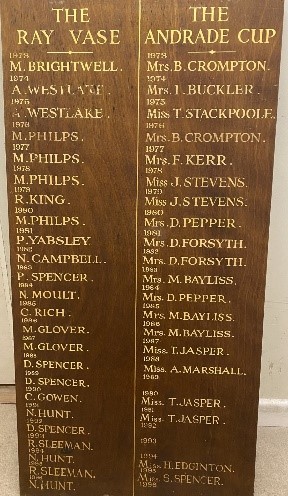
Mike’s name appears at the start of the Honours Boards, and he clearly recalls whilst serving on the Committee the approval of their introduction. Unfortunately, due to incomplete records from earlier years, it was decided that official entries would begin from 1973 onwards. In hindsight, this proved to be a regrettable decision, as earlier champions — including Micheal’s sister, Marie Brightwell, and several other founding members — were never formally recorded.
Michael had a successful run, winning the Ray Vase Cup in 1973. He also won the Founders Cup with his partner J. Fisher and later secured the Presidents Cup in 1975 with partner J. Tongue.
Club Competitions
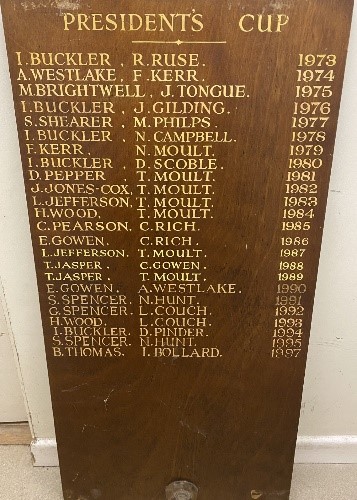
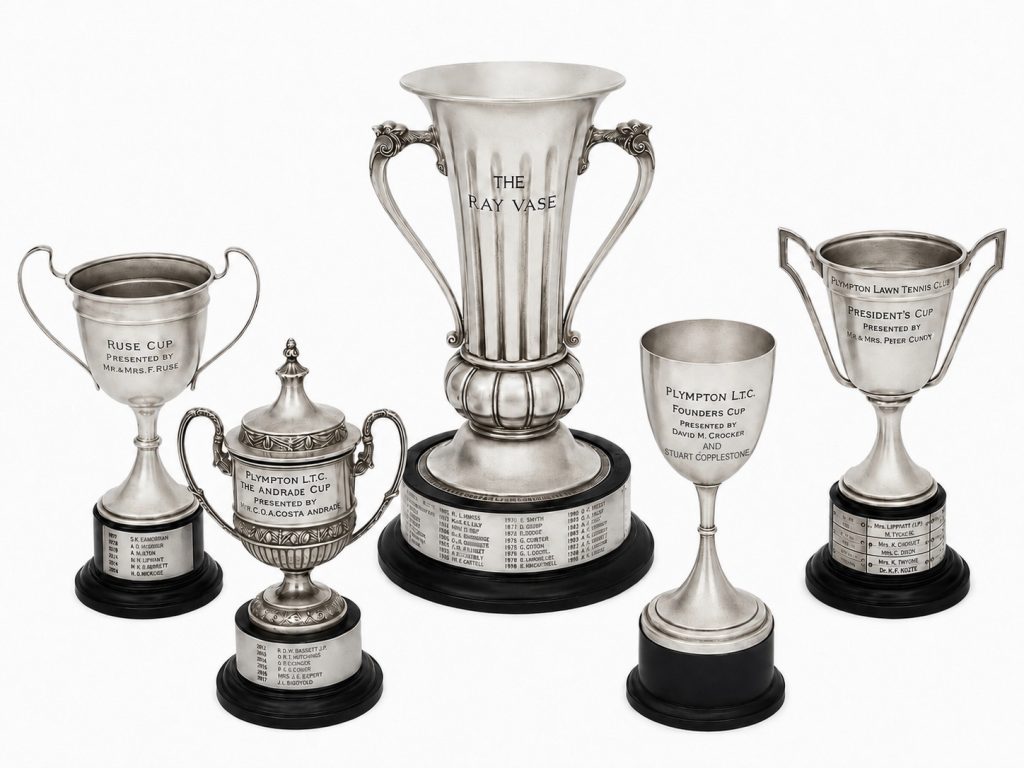
From 1961 to 2015 the club recorded internal championships winners on the cups but also introduced honour boards in 1973 to 1997, and members could compete in five main events:
- Ray Vase Cup – Men’s Singles
- Andrade Cup – Ladies Singles
- President’s Cup – Mixed Doubles
- Ruse Cup – Ladies Doubles
- Founders Cup – Men’s Doubles
These competitions ran for 54 years, reflecting the club’s strong competitive spirit.


A Legacy of Champions
The Story of the Club’s Five Great Cups (1973–1997)
Since 1973, the club’s competitive history has been defined by five prestigious honours: the Ray Vase, Andrade Cup, President’s Cup, Ruse Cup, and Founders Cup. Together, these trophies chart more than two decades of excellence, rivalry, and enduring legacy.
The Individual Crowns
The Ray Vase stands as the ultimate test of individual mastery. Across 24 contested seasons, no name shines brighter than M. Philps, whose four victories between 1976 and 1980 remain the competition’s most dominant run. In a board known for its difficulty to defend, Philps’ late-1970s reign represents one of the purest examples of sustained excellence in club history. D. Spencer and N. Hunt followed with three titles each, reinforcing the Vase’s reputation as fiercely competitive and rarely monopolised.
The Andrade Cup tells a slightly different story. While equally competitive, it produced more repeat champions. Mrs. M. Bayliss and Miss T. Jasper each captured three titles, establishing themselves as the defining figures of their era. The Andrade board reflects depth and consistency, with several two-time winners contributing to a rich and balanced competitive landscape.
Great Partnerships Era
If the singles trophies crown individual brilliance, the pairs competitions reveal adaptability, chemistry, and longevity.
The Andrade Cup was presented to the club in 1962 by Reginald and Muriel Andrade, who traded as Reg & Muriel Andrade Antiques in Devon. Reginald Andrade came from a long history in the antiques trade, with his father Henry de Costa Andrade. (Philip Andrade’s grandfather) operating an antiques business in Plymouth from the early 1900s.
Reginald later joined the family business by the mid 1920’s and went on to run it with his wife Muriel. After Reginald’s death in 1970, their son, Philip Andrade, continued the business. A third-generation antique dealer, Philip had been involved in the trade since the 1950s. He took over the family business in Plympton during the 1960s and later established his own dealership in 1971, which he ran until his retirement in 2000.
The Andrade family’s involvement in antiques is believed to trace back even further, with connections to the notable de Costa Andrade dealers of London.
The President’s Cup, contested annually from 1973 to 1997, became the club’s flagship pairs honour. Two names dominate its history: I. Buckler and T. Moult, each claiming six titles. Notably, neither relied on a single long-term partnership. Their success across multiple combinations highlights versatility and leadership — hallmarks of the club’s golden era.
The Ruse Cup produced perhaps the most commanding record of all. I. Buckler’s nine victories mark the strongest individual hold over any pair’s competition in club history. Close behind, L. Jefferson’s with (eight wins) cemented the 1980s as a period of intense rivalry and high performance. The Ruse board reflects both enduring partnerships and standout individual influence.
Meanwhile, the Founders Cup was shaped most significantly by T. Moult, whose six victories established him as the competition’s benchmark figure. Alongside N. Campbell (five wins) and A. Westlake and R Ruse with (three wins), the Founders Cup captures the formative rivalries of the late 1970s and mid-1980s — years that laid the foundation for sustained excellence.
The Eras of Dominance
Each decade produced its defining figures:
- The 1970s laid the groundwork, with Buckler, Kerr, Westlake, and Campbell establishing early standards.
- The 1980s are widely regarded as the Moult Era, a decade of peak dominance and sustained success in both Founders and President’s competitions.
- The 1990s saw a resurgence of Buckler’s influence, alongside the rise of Gowen, Hunt, and Sleeman, bridging generations of champions.
The All-Time Greats
Across all five trophies, two names rise above the rest.
I. Buckler stands as the club’s most complete competitor — a multi-decade force whose nine Ruse titles and six President’s victories define sustained excellence.
T. Moult, the emblem of 1980s dominance, combined peak performance with consistency, leaving an indelible mark on both the Founders and President’s Cups.
Alongside them, L. Jefferson, N. Campbell, E. Gowen, and M. Philps occupy esteemed positions in the club’s hall of fame, each shaping the competitive identity of their generation

A Tradition That Endures
Taken together, the five cups form more than a record of victories. They tell the story of evolving eras, enduring rivalries, adaptable partnerships, and individual brilliance. Certain surnames — Buckler, Moult, Jefferson, Campbell, Bayliss, Spencer — have become woven into the fabric of the club’s identity.
From the solitary triumph of the Ray Vase to the collaborative mastery required in the President’s and Ruse Cups, the honours boards stand not merely as lists of winners, but as a testament to decades of commitment, competition, and club pride.
The legacy is not simply in the trophies won, but in the standards set for those who follow.


The Clews Cup (1965–1985, reinstated 2007)
The Clews Cup was a special recognition award presented to members who made outstanding or exceptional contributions to their organization. Unlike standard performance awards, it specifically honoured individuals who helped out in a meaningful or “above and beyond” way.
During this twenty-year period, the Cup became a respected symbol of appreciation for dedication and voluntary contribution.
After a 22-year gap, the Clews Cup was reintroduced in 2007, reviving the tradition of honouring exceptional member contributions.
Notable recipients since reinstatement include: Rob Banks, Sarah Blain and Martin Rowe
Introduction of Junior Coaching in the 80’s
Mary Bayliss joined the club in the early 1980’s and soon began coaching our juniors. She also entered the Club Championships and, in 1984, achieved her first win in the Andrade Cup for the Ladies’ Singles. She repeated this success in 1986 and 1987.
It didn’t stop there, in 1983, alongside her daughter Sarah, she won the Ruse Cup for Ladies’ Doubles, and they repeated their success in 1985.
Mary went on to become an ABTO-accredited referee and has devoted much of her life to playing and organising tournaments for juniors. Today Mary has retired for a well-earned rest to pursue her other interests and is now a keen bowler.
Growth and Legacy
In 2002, Peter and Jane Wilson became involved with the club and together with a committee signed a new 25-year lease with the council, thus beginning a new chapter in its history. Their vision was simple but ambitious: to make tennis accessible to everyone, with a particular focus on junior coaching and grassroots development.
Looking back 25 years to when they first joined the club, the situation was very different. The club was shrinking rapidly — still technically “playing in,” but struggling to survive. There were only two junior members and no coaches.
In fact, Jane more or less insisted Peter join so they could guarantee a “four” on Saturday club afternoons and the regular summer club night (which, back then, was on Wednesdays). That small commitment marked the beginning of something much bigger.
From there, Peter and Jane launched Hit & Hope, the forerunner to today’s Rusty Rackets sessions, as part of their efforts to rebuild the club from the ground up. What began as a modest initiative to bring people together on court gradually became the foundation of a thriving, inclusive tennis community.
What followed has been an incredible transformation — from a struggling club with just a handful of players to a vibrant, growing organisation built on opportunity, participation, and community spirit.
With Peter and Jane’s growing involvement in the club, and with Jane Wilson stepping into the role of Head Coach — coaching quickly became a central focus for both the junior and adult members. Their passion and dedication helped shape a thriving coaching culture that continues to benefit players of all ages and abilities.
But the programme didn’t stop there. The introduction of Walking Tennis and Wheelchair Tennis ensured the club became even more inclusive, welcoming players from across the community and creating opportunities for everyone to enjoy the game.


Today (2025), the coaching facilities are still operating successfully, and many current members first began their tennis journey through this very pathway. It remains a cornerstone of the club’s development and community spirit.
Junior Tennis
Junior tennis has long been an important part of the club’s identity. The club is proud to welcome young players as full members, ensuring they feel included in its activities, coaching sessions and social events. Over the years, the club has developed a structured and supportive junior programme designed to nurture players of all ages and abilities, from those picking up a racquet for the first time to teenagers competing in local leagues.
A key part of the junior offering is the Friday coaching programme, which takes place indoors during term time at Hele’s School dome. Coaching follows the nationally recognised framework of the Lawn Tennis Association (LTA) Youth programme, ensuring that children learn using age-appropriate equipment, court sizes and techniques. The early evening sessions are dedicated to red and orange groups, typically for children aged five to nine. Later, the older juniors take part in green and yellow sessions, generally covering ages ten to eighteen. These sessions focus not only on technical development but also on building confidence, teamwork and a love for the game.
During the summer months, junior players enjoy additional opportunities to play and socialise through the Tuesday Junior Club Night. These relaxed sessions give young members the chance to practise match play, take part in fun games and form friendships within the club community.
Competition has always played an important role in developing confidence and sportsmanship amongst our young players. The club supports junior teams competing in local summer leagues and hosts annual Junior Club Championships alongside other seasonal events. These occasions provide valuable match experience whilst maintaining the friendly and encouraging atmosphere that defines our junior section.
Through coaching, club sessions and competitive opportunities, the junior programme continues to foster a welcoming environment where young players can develop their skills, build lasting friendships and enjoy being part of the club’s future.

Over the years, Plympton Lawn Tennis Club juniors have produced remarkable achievements:
In 2014, two junior members had the honour of competing at Wimbledon. Pierce Widdecombe represented the South West in the main championships and delivered an outstanding performance, reaching the semi-finals. That same year, Sam Hopper, just 12 years old at the time, represented Devon in the U14 Road to Wimbledon Championships, progressing to the semi-finals of the consolation event.
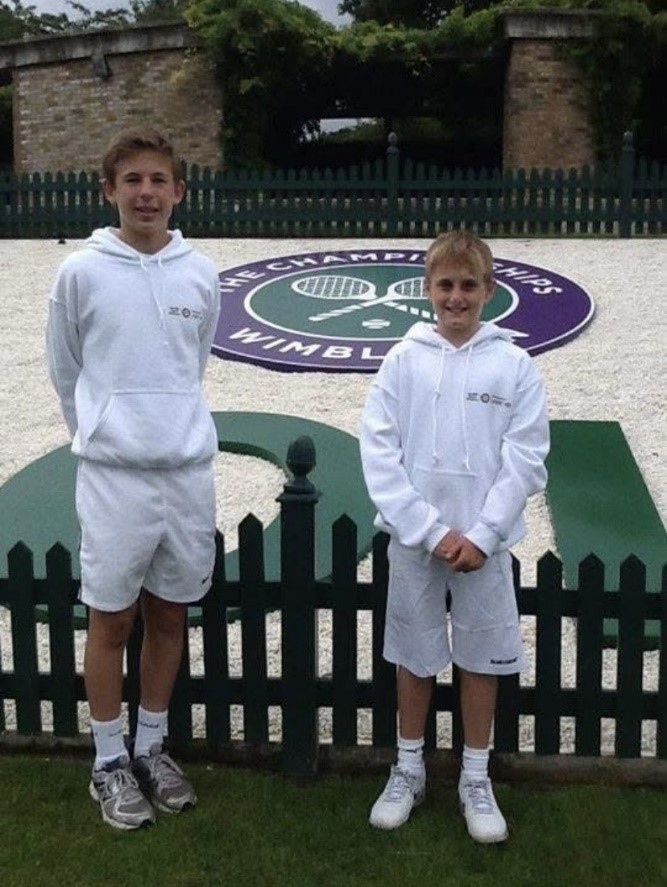
Pierce went on to become the Devon U14 County Champion, while Sam secured the Devon U12 County Title, highlighting the strength of the club’s junior development programme.
These accomplishments reflect the dedication, talent, and commitment nurtured at Plympton Lawn Tennis Club, and remain a proud part of the club’s history.
Helping the Community
The club supports the community in many ways, including taking part in the Christmas Rotary Santa Round and running the Community Coffee Bar at the new Harewood House two weeks of the year.
Members who are not behind the counter serving customers are busy baking cakes and preparing items for the tombola and bric-a-brac stalls.
Half the money raised goes to charitable causes, helping to support those in need within our community.

At the Devon Tennis County Awards 2017, Plympton Lawn Tennis Club was proudly nominated for Club of the Year — and achieved outstanding success by winning this prestigious award.
This achievement is a powerful symbol of the clubs:
- Commitment to excellence in coaching and player development
- Strong community involvement and inclusivity
- High-quality facilities and welcoming environment
- Dedication of volunteers, members, and supporters
Winning Club of the Year reflects not just success on the court, but the strength, spirit, and unity of the entire club community. It recognises the hard work and passion that make the club a leading example of grassroots tennis in Devon.
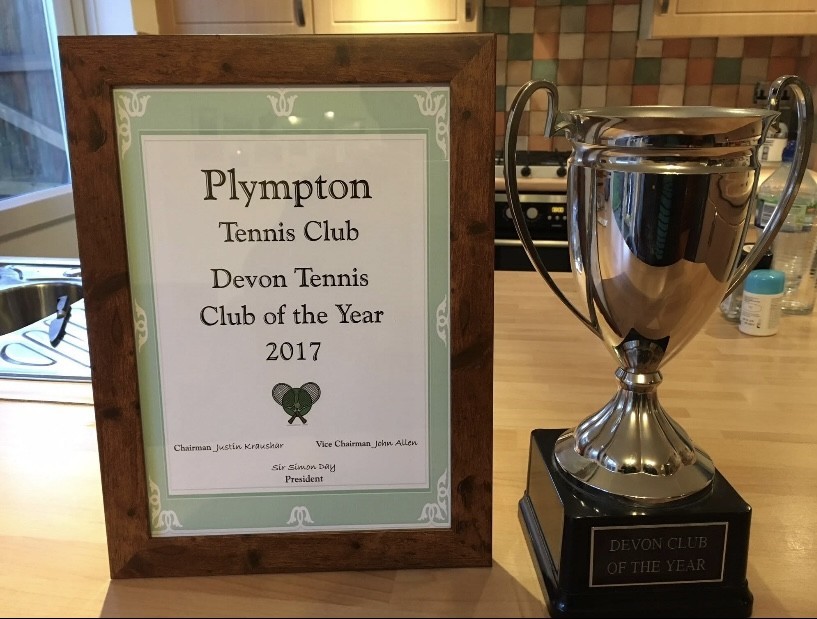
Plympton Tennis Club Celebrates Championship Success 2025
Plympton Lawn Tennis Club continues to thrive under new management, guided by a clear vision to build on past success. The club has earned a strong reputation for being welcoming to all and providing tennis opportunities for players of every age and ability. Proud of its diverse and inclusive community, the club remains fully committed to upholding and strengthening these values.
The 2025 season has been a particularly successful one, both on and off the court, highlighted by impressive performances in the Plymouth & District League and a memorable, sun-soaked Club Championships Finals Day.
Success at the Plymouth & District Presentation Evening, reflected the club’s strength across all levels. The Junior A Team was crowned Division 1 champions, while the Men’s A Team finished runners-up in Division 3 and the Men’s C Team secured runners-up honours in Division 7. Individual merit awards were also presented to Isaac Jackson (Junior Division 1) and Harry Vickers (Men’s Division 7) in recognition of their outstanding performances.
The club also celebrated success at the Plymouth & District Championships. Nick Haley and Fiona Crutchley retained their Mixed Veterans Doubles title, while Nicky Trevaskis and Fiona Crutchley finished as runners-up in the Ladies Veterans Doubles.
Relaunch of club Championships 2025
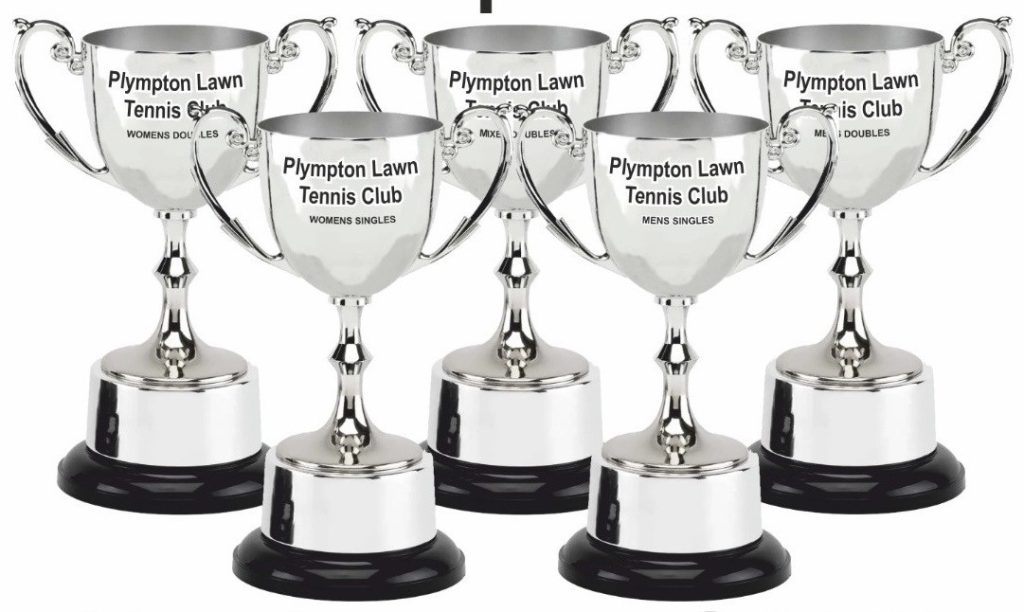
After a 10 year gap the relaunch of the annual Club Championships was reinstated, complete with brand-new trophies and medals, bringing fresh excitement and renewed prestige to one of the club’s most anticipated competitions.
Club Championship Finals Day, held on Saturday 6th September 2025 in glorious sunshine, attracted a fantastic turnout of members and supporters. Helen Wright and Lewis Edwards claimed the Mixed Doubles title, while Nicky Trevaskis and Fiona Crutchley won the Ladies’ Doubles. Lewis Edwards and Richard Cooper triumphed in the Men’s Doubles Fast4 event.
In the singles finals, Fiona Crutchley won the Ladies’ Singles crown with a 6–4, 6–2 victory over Nicky Trevaskis, and Gary Brooks gained the Men’s Singles title after a hard-fought 6–4, 7–5 win against Lewis Edwards.
It must be said that Lewis Edwards delivered a remarkable performance, competing in three gruelling events and triumphing in two of them. He came heartbreakingly close to securing a hat-trick of victories, only to be denied in the final men’s showdown by Gary Brooks. Nevertheless, immense credit must go to Lewis — in an extraordinary display of stamina and determination, it was said he never once stepped off the court for the entire day.

Fiona & Nicky

Richard & Lewis
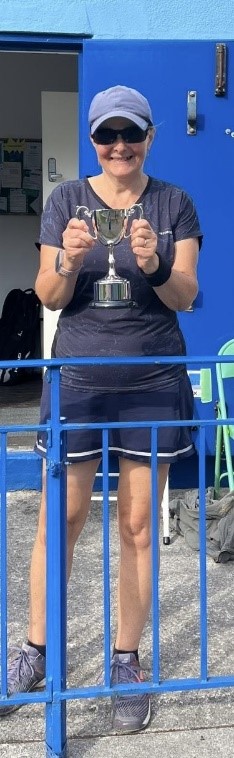
Fiona
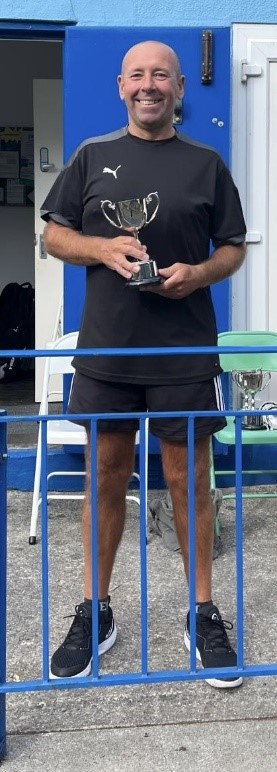
Gary

2025 Championships Silver Wear
Transformation of the Clubhouse
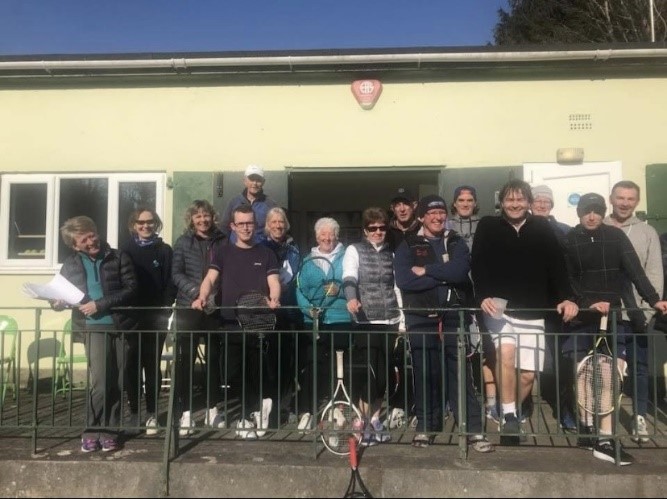
In 2023, the clubhouse underwent an exciting transformation, receiving a fresh coat of paint that proudly showcases the club’s new colours, royal blue. This update marked the beginning of a new chapter for the club, creating a vibrant and unified look.
Past

Present
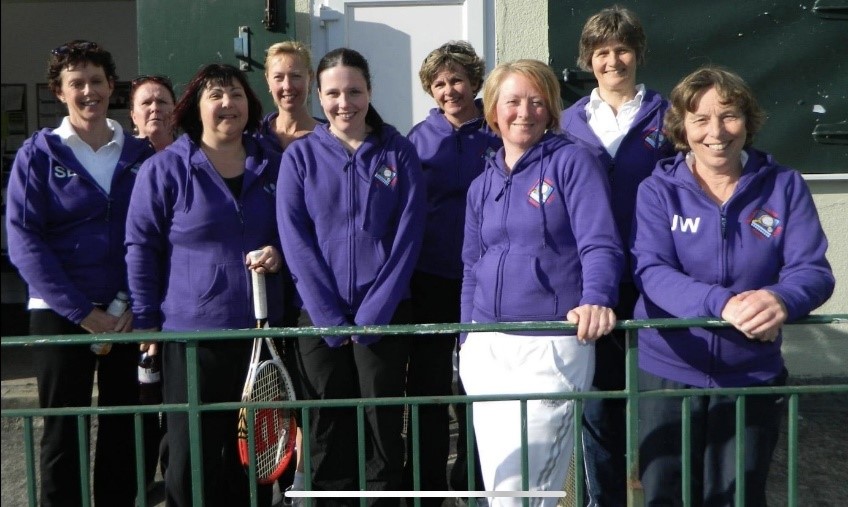
To complement the refreshed clubhouse, new Royal Blue team shirts were designed and produced in preparation for the Summer P&D League. The updated colours and kit brought a renewed sense of pride and identity as the teams headed into the summer season.
Out with the Purple

In with the Royal Blue

New Logo
The club is currently supported by three trustees, who oversee a committee of six members responsible for the day-to-day running and development of the club.
As of 2025, the club has a thriving membership of 131 players, consisting of 25 junior members and 106 adult members.
With a new 25-year lease now secured and the installation of floodlights on all four courts, the future of Plympton Lawn Tennis Club is assured. These developments will enable generations to come to enjoy the club’s excellent facilities, competitive opportunities, and strong community spirit.
Celebrating 65 Years of Excellence
On 14th March 2026, we proudly mark 65 incredible years of our club — a journey built on passion, dedication, and community.
To begin with, it wasn’t looking promising weather-wise—it was raining while we were setting everything up. However, it miraculously cleared around 5pm, and we were even treated to blue skies.
Our club players, both adults and juniors, were out on the courts making the most of the remaining daylight as guests began arriving. Walking down to the clubhouse must have been quite memorable, especially for those who used to play, seeing tennis still in full swing.
By 6pm, the whole place was buzzing with activity, both inside and out. Past players were reconnecting after more than 35 years, which was really special to see. We had the honours boards on display, with all five cups polished and presented in front. There was great interest, with many past players discussing their achievements and successes.
We were delighted to be joined by past players Roger Ruse (co-founder, aged 82), Dot and Mac Forsyth, Mike Brightwell, Andrew Westlake, Maire Elliott, Gill Spencer, Sal (Spencer) Morgan, Dave Spencer, Richard Sleeman, Helen (Wood) Smith, and Anne Thomas. Unfortunately, David Gent, Tony Fuller, Ian Bollard, Neil Campbell, Mary Bayliss, and Neil Hunt were unable to attend.
Most of the play on the courts came to a halt around 6:45pm as the light began to fade. However, anticipation quickly built as players and spectators eagerly gathered for the official switch-on at 7pm. As the crowd assembled, a few words were shared to thank everyone for joining us in this double celebration. Special appreciation was given to all those whose efforts helped the club achieve its goal of installing floodlights on the courts.
We had already decided that Rodger Ruse would have the honour of officially switching on the floodlights. Once he was in position, the countdown began from 10 to 0, with everyone joining in. As we reached zero, Court 1 lit up, followed by Courts 2, 3, and 4. This was met with a huge round of applause, and the atmosphere was filled with excitement and delight as the courts came to life under the lights. It didn’t take long before all courts were full again, with juniors and adults enjoying play under the floodlights.

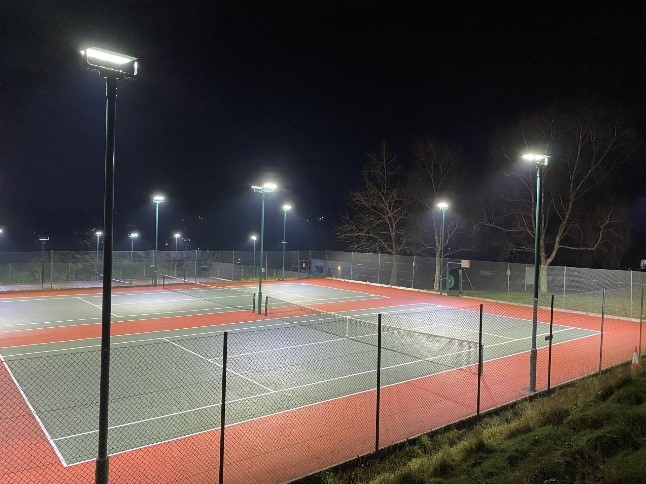
Floodlight switch on by Roger Ruse 2026
This event truly did more than just celebrate our 65th year and the switching on of the floodlights—it brought together past and present members, highlighting the strong and lasting affection people have for the club.
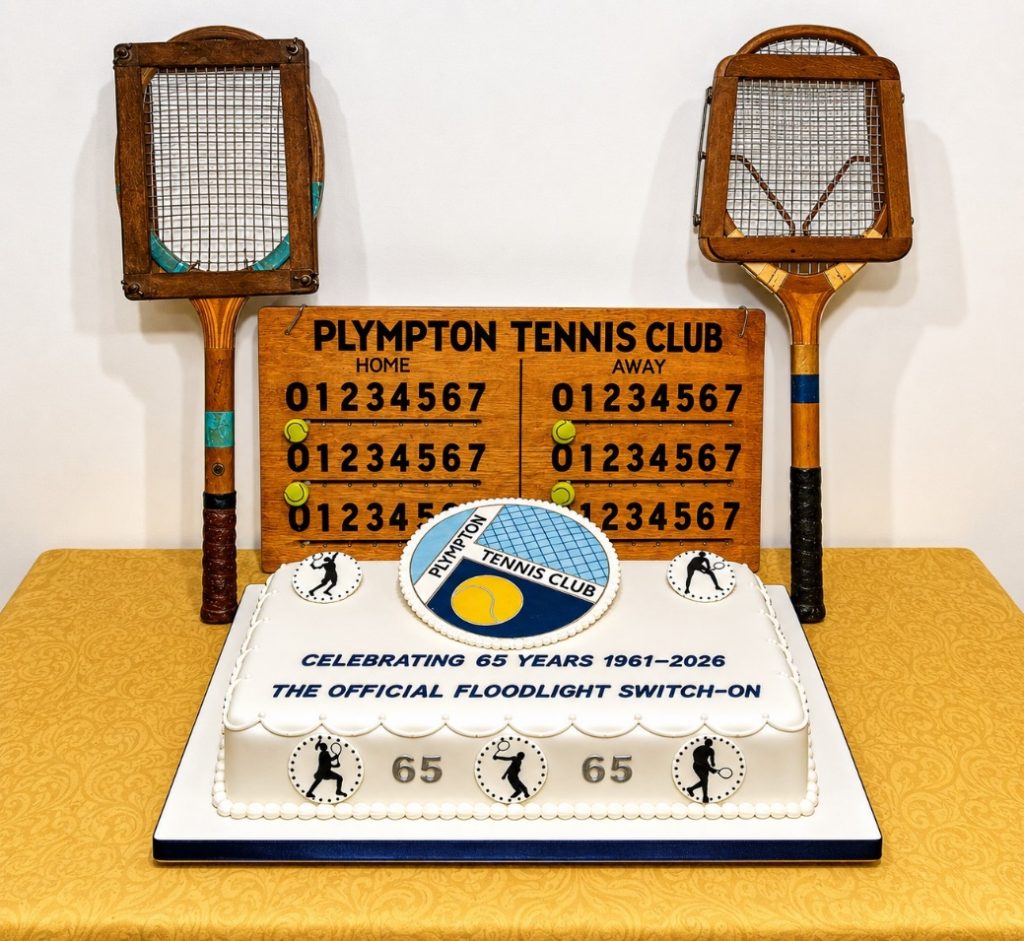
Celebration Cake made by our club member Paul Salvage
Memorable Club Stories
David Gent and the Dunlop Maxply
David Gent dreamed of owning a Dunlop Maxply racket, a coveted item in his student days. Whilst visiting Jersey, he finally purchased one, arranging a small loan with his bank manager to cover the cost. The good news? David still owns that racket today—a symbol of dedication and passion for tennis.
Sal Spencer’s Wimbledon Moment
Sal Spencer, a club member in the 1980s, played tennis for the RAF. Her team earned the chance to compete at Wimbledon. Although primarily a doubles player, Sal was called to play singles as a reserve after enjoying a few drinks. Despite being “half-inebriated,” she took to Court No. 2 and played the match, losing 6–3, 6–3, but leaving behind a story that still raises smiles today.
Neil Hunt – Unexpected Champion
Neil Hunt joined in 1991 when new members had to pass a play test. After passing, he immediately won the Ray Vase Cup, repeating the feat in 1994 and 1996. He also excelled in the President’s Cup mixed doubles, winning with Sal Spencer, and dominated the Founders Cup men’s doubles for four consecutive years with different partners. Neil’s early success highlighted both his talent and the competitive spirit of Plympton Lawn Tennis Club.
The mandatory play test rule was eventually relaxed in 2002 under Peter and Jane, though Neil had already made his mark decades earlier.